Can an Ancient Mind-Body Practice Really Lower Your Blood Pressure? What a New Clinical Trial Found
Vannoni © 2026
Every once in a while, a study comes along that makes me rethink how I talk to my patients about blood pressure. The BLESS trial, published in February 2026 in the Journal of the American College of Cardiology, is one of those studies. It found that an 800-year-old Chinese movement practice called baduanjin lowered systolic blood pressure as effectively as brisk walking and produced reductions comparable to what we see with some first-line blood pressure medications. The results held up at three months and remained significant at one year.
For a cardiologist who spends a large part of every day talking to patients about hypertension, those are numbers worth paying attention to.
Book an appointment with Dr. Meyer to discuss how your working environment may be affecting your blood pressure.
What Is Baduanjin?
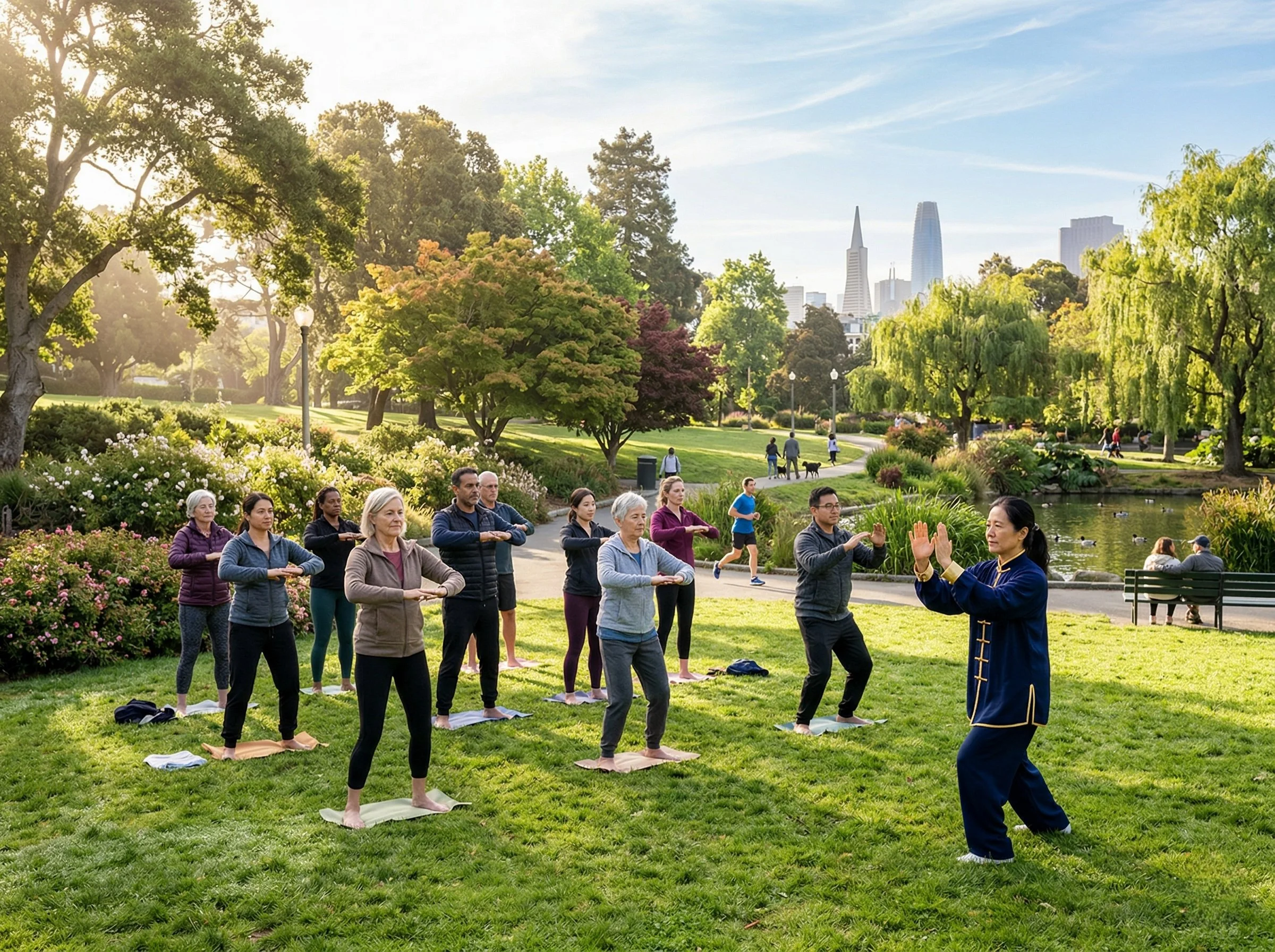
Baduanjin (pronounced roughly "bah-dwahn-jin") is a form of qigong, a traditional Chinese practice that combines slow, deliberate physical movements with controlled breathing and meditative focus. It consists of a standardized sequence of eight movements, each flowing into the next. The entire routine takes about 10 to 15 minutes and requires no equipment, no gym membership, and only a small amount of floor space. You can learn the basics in a single instructional session or from a video, and once you know the movements, you can practice anywhere.
What makes baduanjin different from a stretching routine or basic calisthenics is the integration of breath work and mental focus into every movement. It's not just your muscles that are engaged. Your breathing slows and deepens, your nervous system begins to shift away from the "fight or flight" stress response, and your heart rate and blood pressure tend to follow. Researchers believe this combination of gentle aerobic activity, isometric muscle engagement, flexibility work, and stress reduction is what gives practices like baduanjin their cardiovascular benefit.
What Did the BLESS Trial Actually Show?
The BLESS trial (Baduanjin Lowering Elevated Blood Pressure Study) was the first large, multicenter randomized controlled trial to rigorously test baduanjin's effect on blood pressure. Researchers enrolled 216 adults aged 40 and older across seven community sites in Beijing. All participants had systolic blood pressure in the 130 to 139 mmHg range, which under current ACC/AHA guidelines falls into stage 1 hypertension. None were taking blood pressure medications at the start of the study.
Participants were randomly assigned to one of three groups: baduanjin five days a week, self-directed exercise of their own choosing, or brisk walking.
At 12 weeks, the baduanjin group showed a 3.1 mmHg greater reduction in 24-hour ambulatory systolic blood pressure compared to the self-directed exercise group. Office systolic blood pressure dropped by about 5 mmHg. At 52 weeks, those reductions were sustained, and baduanjin performed comparably to brisk walking with no statistically significant difference between the two.
A 3 to 5 mmHg reduction in systolic blood pressure may not sound dramatic, but at the population level it is profoundly meaningful. Research has consistently shown that even modest reductions in blood pressure translate into significantly lower rates of heart attack, stroke, and cardiovascular death over time. As JACC Editor-in-Chief Harlan Krumholz noted, the blood pressure effect seen in this trial is similar in magnitude to what landmark drug trials have achieved, but without medication, cost, or side effects.
Our Concierge Medicine Services:
At Madison Avenue Cardiovascular & Concierge Medicine, Dr. Mark Meyer offers the most exclusive medical care through premier membership to our concierge medicine services, including:
Personal Doctor
Preferred Appointment Times
24/7 Urgent Care
Own Network of Renowned Specialists
VIP Experience
Executive Annual Physical
Full Body MRI Screening
Genetics Screening
The Meyer Nutrition Plan Included
Why Does This Matter for Patients Who Struggle with Exercise?
I want to be direct about something: this study does not mean you can replace your cardio workouts with slow breathing exercises and call it a day. Cardiovascular exercise, including activities like brisk walking, jogging, cycling, and swimming, remains absolutely vital to your overall heart health. Regular aerobic activity strengthens the heart muscle, improves circulation, lowers cholesterol, reduces inflammation, helps manage weight, and protects against coronary artery disease. The American Heart Association's recommendation of at least 150 minutes per week of moderate-intensity aerobic exercise is grounded in decades of evidence, and nothing about this study changes that.
What this study does offer is an important additional tool, particularly for people who face real barriers to traditional exercise. Many of my patients are older adults with arthritis, balance issues, or chronic pain that makes sustained brisk walking difficult. Others have mobility limitations, safety concerns about walking outdoors, or simply find conventional exercise programs hard to stick with over time. Long-term adherence is one of the biggest challenges in lifestyle-based blood pressure management, and that's precisely where baduanjin appears to shine.
The practice is gentle enough for people with limited mobility. It can be done indoors in a small space. It requires no special clothing or equipment. And because the movements are slow and flowing rather than jarring, the risk of injury is extremely low. The BLESS trial reported no significant difference in adverse events across any of the three groups.
Perhaps most importantly, participants in the baduanjin group maintained their blood pressure improvements for an entire year, even after the structured monitoring period ended. That kind of long-term adherence is rare in lifestyle intervention studies and suggests that people genuinely enjoy the practice enough to keep doing it on their own.
How Does Baduanjin Fit Into a Heart-Healthy Lifestyle?
I see baduanjin as a complement to a broader cardiovascular health strategy, not a substitute for one. For patients who are already active, adding a mind-body practice like baduanjin can address something that traditional cardio does not: stress management. Chronic psychological stress raises blood pressure, promotes inflammation, disrupts sleep, and contributes to unhealthy eating patterns. Practices that engage the parasympathetic nervous system, the body's "rest and digest" mode, can help counteract these effects.
For patients who are currently sedentary and feel overwhelmed by the prospect of starting an exercise program, baduanjin can serve as an accessible entry point. Starting with 10 to 15 minutes of gentle, structured movement is far less intimidating than committing to 30 minutes on a treadmill, and the blood pressure benefits demonstrated in this trial are real and clinically meaningful. Over time, as patients build confidence and physical capacity, the goal would be to add more traditional aerobic activity into the mix.
Here is how I would frame a practical approach for my patients:
If you are already exercising regularly, consider adding a mind-body practice like baduanjin, tai chi, or yoga a few times a week. These practices can help manage stress, lower blood pressure, and improve flexibility and balance in ways that running or cycling alone may not.
If you are not currently exercising at all, baduanjin is a legitimate, evidence-based place to start. Learn the eight movements from an instructional video or a class, practice for 10 to 15 minutes most days of the week, and build from there. Your blood pressure will likely benefit, and you may find that the habit of daily movement becomes easier to expand over time.
And regardless of where you are on the fitness spectrum, don't neglect aerobic exercise. Your heart is a muscle, and it needs to be worked. Walking, swimming, cycling, dancing: the specific activity matters less than doing something that raises your heart rate on a regular basis.
Our Main Tenets for Bespoke Concierge Medical Care
At Madison Avenue Cardiovascular & Concierge Medicine medical care comes with a vision that considers the wholeness of the patient as a person in a journey for wellbeing. Dr. Mark Meyer will ensure you have premium access to the best internal medicine and cardiology medical services in New York, in the most convenient, exclusive, elegant and private setting on Madison Avenue. For more than 25 years, Dr. Meyer has provided elite medical care according to the highest standards. Now you can join our concierge membership and access the most sophisticated bespoke medical and wellness care in Manhattan.
Book an appointment with Dr. Meyer to discuss membership in his Concierge Medicine practice today.
What Is The Bigger Picture?
High blood pressure is the single most common modifiable risk factor for heart disease worldwide. It is also one of the most undertreated. Millions of Americans have blood pressure readings in the 130 to 139 range, the exact population studied in the BLESS trial, and many of them are not on medication. For these individuals, lifestyle interventions are the first line of defense.
The fact that an 800-year-old practice can produce blood pressure reductions comparable to walking and comparable to some medications, in a rigorous randomized trial published in one of the world's top cardiology journals, is genuinely encouraging. It tells us that there are more tools in the toolbox than we sometimes appreciate.
As Dr. Krumholz put it, this study demonstrates how ancient, accessible, low-cost approaches can be validated through high-quality research. And for my patients, the practical takeaway is simple: if something safe, free, and gentle can meaningfully lower your blood pressure, it deserves a place in the conversation.
Sources
Pu B, Zhang L, Sun Y, et al. "Effect of Baduanjin on Blood Pressure Among Individuals With High-Normal Blood Pressure: A Multicenter, Open-Label, Blinded-Outcome Randomized Controlled Trial." Journal of the American College of Cardiology. 2026;87(12):1436-1449. https://www.jacc.org/doi/10.1016/j.jacc.2026.01.014
American College of Cardiology. "BLESS: Ancient Mind-Body Practice Proven to Lower BP." February 18, 2026. https://www.acc.org/latest-in-cardiology/journal-scans/2026/02/17/14/32/bless
American College of Cardiology. "Ancient Mind-Body Practice Proven to Lower Blood Pressure in Clinical Trial." Press Release. February 18, 2026. https://www.acc.org/About-ACC/Press-Releases/2026/02/18/14/58/Ancient-Mind-Body-Practice-Proven-to-Lower-Blood-Pressure-in-Clinical-Trial
TCTMD. "Baduanjin, a Traditional Chinese Practice, Lowers BP." February 20, 2026. https://www.tctmd.com/news/baduanjin-traditional-chinese-practice-lowers-bp
American Heart Association. "Recommendations for Physical Activity in Adults and Kids." https://www.heart.org/en/healthy-living/fitness/fitness-basics/aha-recs-for-physical-activity-in-adults
Whelton PK, Carey RM, Aronow WS, et al. "2017 ACC/AHA/AAPA/ABC/ACPM/AGS/APhA/ASH/ASPC/NMA/PCNA Guideline for the Prevention, Detection, Evaluation, and Management of High Blood Pressure in Adults." Journal of the American College of Cardiology. 2018;71(19):e127-e248. https://www.jacc.org/doi/10.1016/j.jacc.2017.11.006
Zou L, Yeung A, Quan X, et al. "Mindfulness-Based Baduanjin Exercise for Depression and Anxiety in People with Physical or Mental Illnesses: A Systematic Review and Meta-Analysis." International Journal of Environmental Research and Public Health. 2018;15(2):321. https://pubmed.ncbi.nlm.nih.gov/29439478/