The Coronary Artery Calcium Score: The Heart Test Every Patient Over 40 Should Know About
Vannoni © 2026
A patient came to see me last spring, 52 years old, running the Central Park loop three times a week, cholesterol a little high but not alarming. His father had a heart attack at 56. Another doctor had mentioned a statin, he had read conflicting things online, and he wanted my opinion.
This is one of the most common conversations I have in my Midtown Manhattan East Side office, and it is what a coronary artery calcium scan was built to settle.
Background: As plaque is laid down in the arteries (if that happens), the body will calcify that plaque in order to turn the newly laid plaque from soft and gelatinous to stable and less vulnerable to explosion (heart attack or an acute coronary syndrome). This test only sees that there is plaque if it has calcified. The time for this conversion is not specifically known, but it takes a while. So noncalcified plaque will not be indicated by this test, even with a Calcium score of zero. More on this in the next blog.
What Does a Calcium Scan Actually Measure?
Standard risk calculators estimate your odds of a heart attack or stroke from your age, sex, blood pressure, cholesterol, and smoking status. They are useful, but they are averages. They tell me what happens to people like you, not what is happening inside your arteries.
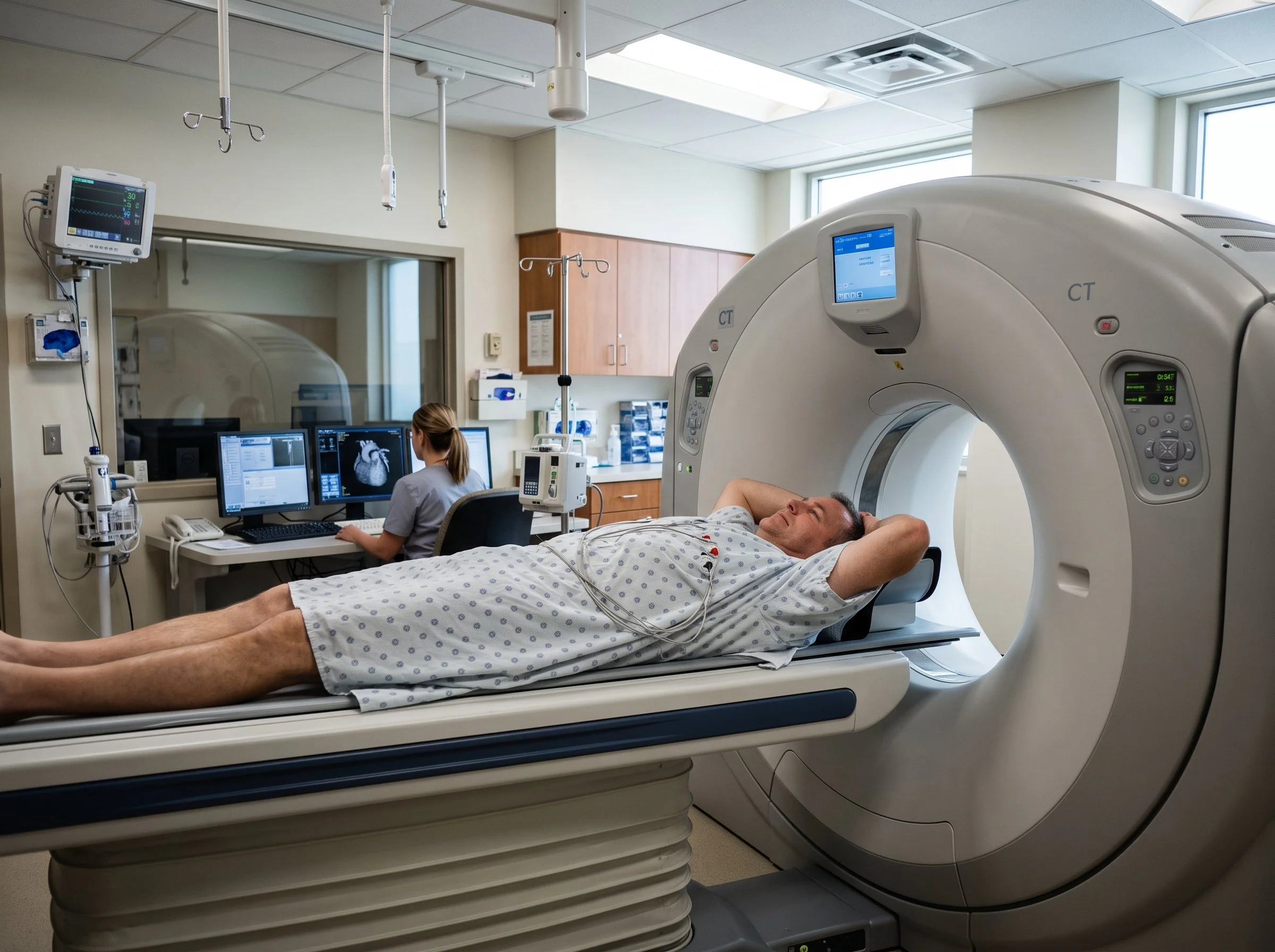
A coronary artery calcium (CAC) scan does. It is a quick CT scan of the heart that looks for calcium deposits in the walls of the coronary arteries. Calcium there is a marker of plaque, so the scan gives direct evidence of artery disease rather than an estimate. The result is a single number, called an Agatston score.
In a Cleveland Clinic study of 5,324 adults without symptoms, adding calcium scores to standard risk models changed the risk category for nearly half of them. Some moved up, many moved down.
At Madison Avenue Concierge Medicine, Dr. Meyer keeps himself and his patients on the cutting edge of every new medical development and study.
That’s the Madison Avenue Concierge Medicine advantage.
Be in the know regarding your health.
No excuses.
Join Madison Avenue Concierge Medicine
What Is a Coronary Artery Calcium Scan Like?
Patients are often surprised by how simple it is:
No IV, no contrast dye, no needles, no fasting
Roughly 10 to 15 minutes in the scanner, with a few breath holds
A low dose of radiation
Results usually within a day or two
Insurance sometimes covers it. When it does not, the American Heart Association puts typical out of pocket costs between $50 and $250.
What Does Your Number Mean?
Scores are grouped into broad bands:
0: No detectable calcium. Very low short-term risk.
1 to 99: A small amount of plaque. Low to intermediate risk.
100 to 399: A moderate amount. Intermediate to high risk.
400 or higher: A significant plaque burden, with risk approaching that of someone who has already had a cardiac event.
Context matters. A score of 50 in a 45 year old man is a louder alarm than the same score in a 75 year old, because calcium accumulates with age. That is why I read a score alongside a percentile for your age and sex.
Join Our Concierge Membership Program
After the first meeting, you can apply to become a member in our premium concierge program and access our elite services, including our executive annual physical. The program consists in an annual membership fee giving access to our premium services.
BOOK AN APPOINTMENT
Why Is Zero One of the Best Numbers in Cardiology?
When a score comes back at zero, I tell the patient it is one of the most reassuring results I can deliver.
A 2025 review of calcium scoring in people without symptoms described a zero score as carrying very low event rates. One analysis in that review found major cardiac events in 2.4% of people with a zero score compared with 6.9% of those with any calcium at all. A zero score also corresponds to a "vascular age" younger than your actual age.
Cardiologists call this the warranty period. A zero score has been linked to low risk for roughly three to seven years, and in one study of adults without symptoms the window extended to 15 years, so a rescan is usually a question of five to ten years out rather than next year.
A zero is not a free pass. It does not rule out risk entirely, and it does not undo smoking, diabetes, or a strong family history. But it buys real breathing room. The next blog will explain how to really nail down what is happening inside the coronary arteries.
Who Benefits Most, and Who Can Skip It?
This is not a test for everybody. The 2026 ACC/AHA dyslipidemia guideline gives calcium scoring its strongest level of recommendation for intermediate-risk and selected borderline-risk adults when a treatment decision is genuinely uncertain. The AHA frames it the same way: it is most useful if you are undecided about starting a statin, or restarting one after side effects.
Good candidates include:
Adults in their 40s and 50s with borderline or intermediate calculated risk
People with a family history of early heart disease
People with high cholesterol who are weighing medication
Anyone who stopped a statin and is unsure about trying again
It adds less for people already clearly high risk who will be treated regardless, people at very low risk, and anyone with symptoms such as chest pain, who needs a different workup. On timing, the literature points to roughly age 40 to 45 for men and somewhat later for women, generally after 50 if risk factors are present.
Our Concierge Medicine Services
At Madison Avenue Cardiovascular & Concierge Medicine, Dr. Mark Meyer offers the most exclusive medical care through premier membership to our concierge medicine services.
How Does the Score Change What I Prescribe?
This is where the test earns its keep. Under current guidance, cholesterol targets tighten as the score climbs: an LDL goal under 100 for a score of 1 to 99, under 70 for 100 to 299, and under 55 for 300 and above. Scores past 1,000 are managed as aggressively as if the patient had already had a heart attack. A zero, in the right patient, can support holding off on a statin and rechecking later. In the Cleveland Clinic data, about a quarter of patients with a zero score were already on one.
What Can’t The Scan Tell You?
Calcium scans detect calcified plaque, not the softer plaque that matters more in younger patients. They do not show whether an artery is narrowed enough to restrict blood flow, so this is not the right test for someone with symptoms. And because statins can increase calcium density as plaque stabilizes, repeat scores in treated patients are hard to interpret and are not a report card on your medication.
What Are Some Practical Notes for New Yorkers?
Calcium scans are widely available across Manhattan and the outer boroughs, and the appointment fits between meetings. Three suggestions:
Ask for the full report, including your percentile for age and sex, not just the single number.
Bring recent lipid labs and blood pressure readings to the follow-up visit so we can read everything together.
Confirm the cost ahead of time, since coverage varies by plan and this is often a cash-pay test.
And keep walking. No score, high or low, replaces the daily movement this city makes easy.
If you are over 40, undecided about a statin, or carrying a family history that worries you, a coronary artery calcium scan is one of the highest-value tests in preventive cardiology. It takes 15 minutes, needs no needles, and replaces guesswork with a look at your own arteries. A high score tells us to act now. A zero may be the most reassuring number you hear all year. Either way, the decision gets made with real information instead of a population average.
No one can skip it. The age-and-gender-adjusted percentile also independently predicts risk. Anyone in the 75th percentile or above is at highest risk, though the 50th to 74th percentile may require treatment as well, depending on the individual risk profile of the patient. As we age, some calcified plaque is normal, so that an "elevated Calcium Score" means that different risk levels and percentiles have different implications, so it’s best to have a discussion with your provider.
These tests can be done in patients younger than 40, but the results may not be as revealing due to the subject’s lower age, meaning the body may not have had time to lay down a calcium cap, and thus embryonic, noncalcified plaque will be missed.
Sources
Coronary Artery Calcium Scoring Improves Accuracy of Cardiovascular Risk Screening. Cleveland Clinic Consult QD. https://consultqd.clevelandclinic.org/coronary-artery-calcium-scoring-improves-accuracy-of-cardiovascular-risk-screening
Role of Coronary Artery Calcium Score in Risk Stratification of Asymptomatic Individuals. PMC. 2025. https://pmc.ncbi.nlm.nih.gov/articles/PMC12653156/
American Heart Association. Coronary Artery Calcium Test. https://www.heart.org/en/health-topics/heart-attack/diagnosing-a-heart-attack/cac-test
2026 ACC/AHA/Multisociety Guideline on the Management of Dyslipidemia. Journal of the American College of Cardiology. https://www.jacc.org/doi/10.1016/j.jacc.2025.11.016
Understanding the 2026 Dyslipidemia Guidelines: CAC Scoring, Risk Enhancers, and Incidental CAC. HCPLive. https://www.hcplive.com/view/understanding-the-2026-dyslipidemia-guidelines-2026-guidelines-cac-scoring-risk-enhancers-incidental-cac
New Guideline Recommends CAC Scoring When There Is Uncertainty Regarding Benefit From Statins. Society of Cardiovascular Computed Tomography. https://scct.org/news/427405/New-guideline-recommends-CAC-scoring-when-there-is-uncertainty-regarding-benefit-from-statins.htm
Guideline-Directed Application of Coronary Artery Calcium Scores for Primary Prevention of Atherosclerotic Cardiovascular Disease. JACC: Cardiovascular Imaging. 2025. https://www.jacc.org/doi/10.1016/j.jcmg.2024.12.008
Major Global Coronary Artery Calcium Guidelines: Key Points. American College of Cardiology. https://www.acc.org/latest-in-cardiology/ten-points-to-remember/2022/10/04/19/19/major-global-coronary-artery
Coronary Artery Calcium Scan Cost and Savings Tips. GoodRx. https://www.goodrx.com/health-topic/heart/coronary-artery-calcium-scan-cos