Beyond the Calcium Score: What a CT Angiogram Adds, and When You Need One
© 2026 Vannoni
In my last post I called a coronary calcium score of zero one of the most reassuring numbers in cardiology. Several patients came back with the same excellent question: if that coronary calcium scan only detects calcium, what about plaque that has not turned to calcium yet?
That is the right question, and it’s why a second test exists. Coronary CT angiography, usually shortened to CTA, picks up where the calcium score stops.
Do These Two Scans Have Two Different Jobs?
Both tests use a CT scanner and both look at your coronary arteries, but they answer different questions.
A calcium score is a quick, dye-free scan that measures calcified plaque and returns one number. It is a risk tool, and it helps decide whether you need cholesterol medication.
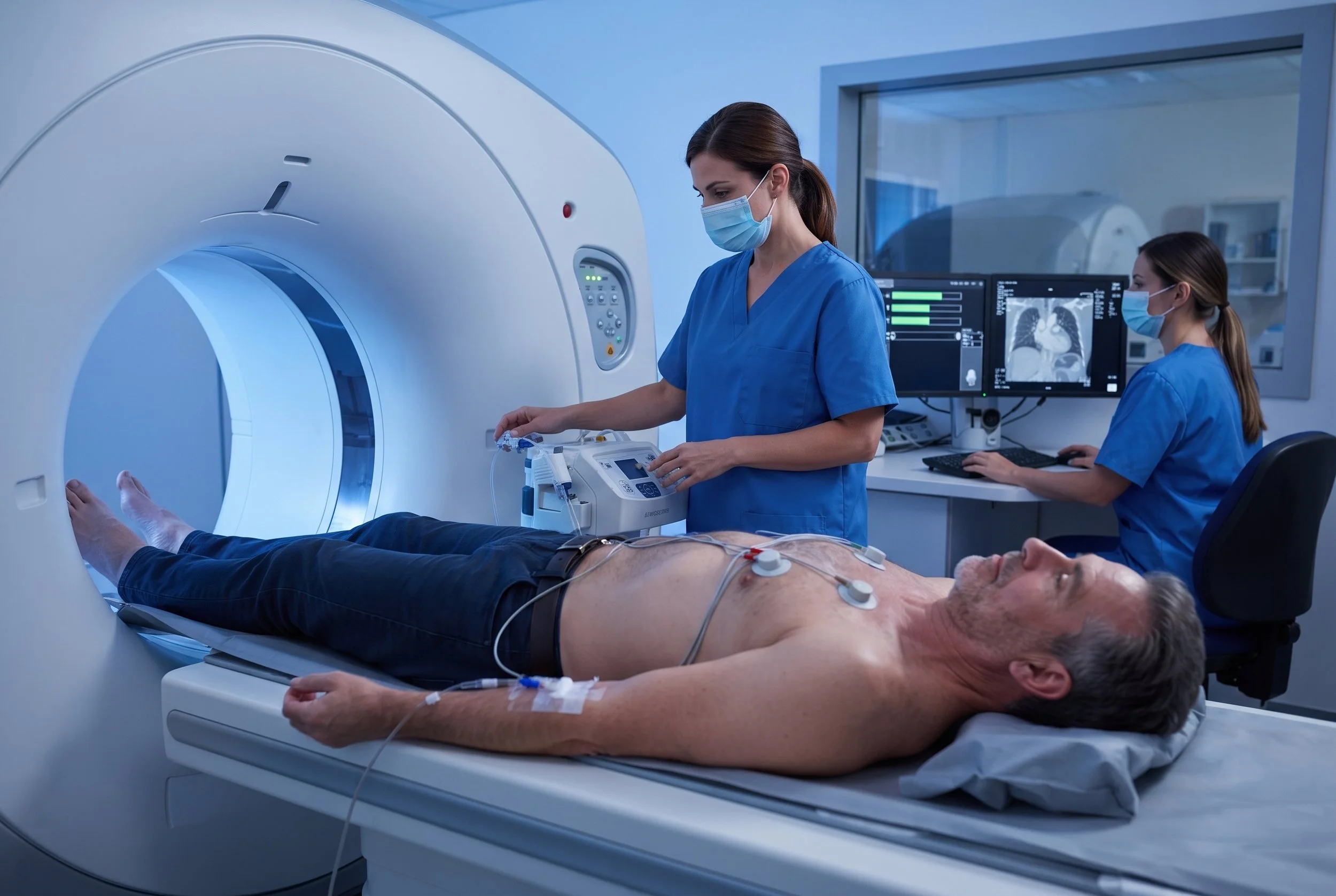
A CT angiogram uses iodine contrast dye through an IV so the inside of your arteries lights up. It is an anatomy test. It shows soft plaque that has not calcified, calcified plaque, and if there are blockages, where each blockage sits, and how narrow each artery actually is.
At Madison Avenue Concierge Medicine, Dr. Meyer keeps himself and his patients on the cutting edge of every new medical development and study.
That’s the Madison Avenue Concierge Medicine advantage.
Be in the know regarding your health.
No excuses.
Join Madison Avenue Concierge Medicine
What Does a CTA Shows That a Calcium Score Cannot?
Three things, mainly.
First, non-calcified plaque. Younger patients in particular can have meaningful soft plaque with a calcium score of zero, since calcification is partly a sign of plaque that has stabilized with age.
Second, the degree of narrowing. A high calcium score tells me there is a lot of plaque, but not whether an artery is 30% narrowed or 80% narrowed, and that distinction changes management.
Third, the map. For a patient who may be headed toward a catheter procedure, knowing the location and shape of each blockage in advance is valuable.
What Does the Test Involve?
A CTA asks more of you than a calcium scan:
Fast for about eight hours, and skip caffeine for roughly 12, since a fast heart rate blurs the images
You may get a beta blocker to slow your heart and nitroglycerin to open the arteries
An IV delivers the contrast dye
The scan takes seconds, but plan on up to an hour for the visit
Radiation exposure is higher than a calcium scan, though modern scanners have cut doses substantially
Most people drive themselves home and resume normal activity right away.
What’s Evidence Is There From Ten Years of Following-Up?
The strongest data comes from SCOT-HEART, a Scottish trial that randomized 4,146 patients with stable chest pain to standard care with or without a CTA and followed them for a decade.
At 10 years, death from coronary heart disease or nonfatal heart attack occurred in 6.6% of the CTA group compared with 8.2% of those managed without it, with the benefit coming mainly from fewer heart attacks. Rates of catheterization and stenting were similar in the two groups, so the scan did not lead to more procedures. It led to better-targeted prevention, and patients in the CTA arm were still more likely to be on preventive medication a decade later. Earlier in the trial, the scan changed the diagnosis in 27% of patients and the treatment plan in 23%.
That is the real lesson. The value came from clarity about who needed aggressive treatment, not from finding more arteries to open.
Join Our Concierge Membership Program
After the first meeting, you can apply to become a member in our premium concierge program and access our elite services, including our executive annual physical. The program consists in an annual membership fee giving access to our premium services.
BOOK AN APPOINTMENT
Should I Get A CT Before a Catheter?
The DISCHARGE trial asked a different question: for stable chest pain with an intermediate likelihood of disease, should the first test be a CT scan or an invasive catheter angiogram?
Among 3,561 patients, the rate of cardiovascular death, heart attack, or stroke was 2.1% in the CT group and 3.0% in the invasive group, a difference that did not reach statistical significance. Major procedure-related complications were clearly lower with CT, at 0.5% versus 1.9%. For many patients, starting with the scan is both safer and sufficient.
This is a case-to-case decision to be guided by your cardiologist.
What Is Artificial Intelligence Adding?
This is the part of the field moving fastest. Software can now measure total plaque volume and composition from a CTA with a precision no human reader can match by eye.
A 2025 consensus statement in Nature Reviews Cardiology from the QCI Study Group, built on plaque data from SCOT-HEART and DISCHARGE, proposed age- and sex-adjusted percentile curves for plaque volume. Two conclusions stand out: the presence of any plaque should prompt medical treatment, and total plaque volume at or above the 70th percentile for your age and sex warrants high-intensity treatment.
The question is shifting from “is an artery blocked?” to “how much disease is in these arteries, and how does it compare to others your age?” That is a better question for prevention. These thresholds are new and still being tested, so I treat them as one input rather than a verdict.
How Do I Use the Two Tests Together?
There is no universal sequence, but a few patterns hold:
No symptoms, deciding about a statin. The calcium score comes first. It is cheaper, faster, needs no dye, and often settles the question by itself.
Symptoms such as chest pressure or shortness of breath with exertion. A calcium score is the wrong test here. A CTA or a functional test is appropriate.
A zero calcium score with symptoms or a strong family history of early heart disease. This is where a CTA earns its place, because soft plaque can hide behind that zero.
A very high calcium score. Dense calcium can obscure CTA images, so the next step may be a stress test rather than more anatomy.
Our Concierge Medicine Services
At Madison Avenue Cardiovascular & Concierge Medicine, Dr. Mark Meyer offers the most exclusive medical care through premier membership to our concierge medicine services.
Who Should Not Have a CTA?
The contrast dye is the main consideration. Patients with significant kidney disease, a known iodine contrast allergy, or who are pregnant need a different approach. An irregular or very fast heart rhythm can also degrade the images. And if you are already clearly high risk and committed to maximal treatment, the scan may not change anything.
What Are Some Practical Notes for New Yorkers?
Confirm cost and coverage first. A CTA costs considerably more than a calcium score, and coverage is better when symptoms are documented.
Bring your medication list, including anything for diabetes, which may need to be paused around the dye.
Ask whether the center uses AI plaque quantification. It is not available everywhere, and the extra detail is useful.
Plan around the caffeine rule. For most New Yorkers that is the hardest instruction on the list.
A calcium score and a CT angiogram are not competitors. The calcium score is the efficient first look for someone without symptoms who needs a clearer sense of risk. The CTA is the detailed examination for someone with symptoms, a worrying family history, or a result that does not fit the clinical picture. Used in the right order, they let us treat the disease we can see rather than the risk we estimate. If you have had a calcium score and still have questions, bring the report in and we can decide whether the next look is worth taking.
If a patient has preexisting plaque, once a statin is added, it helps to promote calcification of the plaque which stabilizes it. However, that will raise the calcium score, which in this case is a good thing. The most useful calcium scores are in statin-naive or treatment-naive patients. So the CTA as a follow up is the only reliable way to assess disease progression or plaque composition once calcification begins, either prior to a statin (which speaks to the long duration of plaque, as calcification takes a long but not known time) or after a statin, the calcium score becomes inconclusive.
Sources
Coronary CT Angiography-Guided Management of Patients With Stable Chest Pain: 10-Year Outcomes From the SCOT-HEART Randomised Controlled Trial in Scotland. The Lancet. 2025. https://www.thelancet.com/journals/lancet/article/PIIS0140-6736(24)02679-5/fulltext
Coronary CT Angiography-Guided Management of Stable Chest Pains Shows Benefit Out to 10 Years. Cardiovascular News. https://cardiovascularnews.com/coronary-ct-angiography-guided-management-of-stable-chest-pains-shows-benefit-out-to-10-years/
Coronary CT Angiography Evaluation With Artificial Intelligence for Individualized Medical Treatment of Atherosclerosis: A Consensus Statement From the QCI Study Group. Nature Reviews Cardiology. 2025. https://www.nature.com/articles/s41569-025-01191-6
CT or Invasive Coronary Angiography in Stable Chest Pain (DISCHARGE). New England Journal of Medicine. 2022. https://www.nejm.org/doi/full/10.1056/NEJMoa2200963
Diagnostic Imaging Strategies for Patients With Stable Chest Pain and Intermediate Risk of Coronary Artery Disease (DISCHARGE trial summary). American College of Cardiology. https://www.acc.org/latest-in-cardiology/clinical-trials/2022/03/07/14/51/discharge
2021 AHA/ACC/ASE/CHEST/SAEM/SCCT/SCMR Guideline for the Evaluation and Diagnosis of Chest Pain. Circulation. https://www.ahajournals.org/doi/10.1161/CIR.0000000000001029
CT Coronary Angiogram. Mayo Clinic. https://www.mayoclinic.org/tests-procedures/ct-coronary-angiogram/about/pac-20385117
Role of Coronary Artery Calcium Score in Risk Stratification of Asymptomatic Individuals. PMC. 2025. https://pmc.ncbi.nlm.nih.gov/articles/PMC12653156/
First Scan, Then Treat: 10 Years of the SCOT-HEART Study. PMC. https://pmc.ncbi.nlm.nih.gov/articles/PMC13147259/
2026 ACC/AHA/Multisociety Guideline on the Management of Dyslipidemia. Journal of the American College of Cardiology. https://www.jacc.org/doi/10.1016/j.jacc.2025.11.016