The Shingles Shot May Be Helping Your Brain, Too, Along With Your Heart
Vannoni © 2026
For most of my career, if a patient asked me whether they should get the shingles vaccine, I would tell them yes and then hand them off to their primary care doctor. It was a good vaccine that prevented a painful, sometimes debilitating rash. It was not, in any meaningful sense, cardiology's business.
That has changed. Over the past 18 months, a series of large, well-designed studies has landed on the same surprising conclusion. The shingles vaccine appears to lower the risk not only of dementia, but of heart attack, stroke, and heart failure as well. The effect sizes are the kind that get a cardiologist's attention, and the biology behind them makes sense.
Here is what the research shows, why it matters for your heart and your brain, and how I am now thinking about this vaccine in my Midtown Manhattan practice.
At Madison Avenue Concierge Medicine, Dr. Meyer keeps himself and his patients on the cutting edge of every new medical development and study.
That’s the Madison Avenue Concierge Medicine advantage.
Be in the know regarding your health.
No excuses.
Join Madison Avenue Concierge Medicine
What Was the Dementia Connection That Started All This?
The story picked up steam in 2025 with a natural experiment out of Wales, published in the journal Nature. Because Welsh public health authorities had rolled out the shingles vaccine to people born on or after a specific date, researchers could compare nearly identical groups of adults, some eligible and some just barely not, and see what happened over the following years. Vaccinated individuals had a roughly 20 percent lower risk of developing dementia over seven years.
Since then, the evidence has piled up. A large observational study published in Annals of Internal Medicine in 2026 followed about 510,000 older adults in skilled nursing facilities and found that those who received the current Shingrix vaccine had a 24 percent lower risk of developing dementia over four years compared with those who did not. Another study published in Lancet Neurology in 2025 examined data from multiple countries and reached similar conclusions.
These are observational studies, which means they show strong association rather than definitive cause and effect. But when this many independent studies across different populations point the same direction, most of us take the signal seriously.
Get The Meyer Nutrition Plan
Which Cardiovascular Findings Should Get Your Attention?
For patients of a cardiology practice, the more recent news is arguably even more striking.
At the 2025 European Society of Cardiology Congress in Madrid, researchers presented a global meta-analysis pulling together 19 studies on shingles vaccination and cardiovascular outcomes. Vaccinated adults had a 16 to 18 percent lower risk of major cardiovascular events, including heart attacks and strokes, compared with unvaccinated adults.
A large South Korean study of over one million people, published in the European Heart Journal in May 2025, found that shingles vaccination was associated with a 23 percent lower risk of cardiovascular disease overall, with protective effects appearing to last up to eight years.
In March 2026, researchers presented findings at the American College of Cardiology's Annual Scientific Session that were even more targeted. Looking at over 123,000 patients age 50 or older with existing atherosclerotic disease, the population I see every day in clinic, vaccinated patients were 32 percent less likely to suffer a heart attack, 25 percent less likely to have a stroke, and 25 percent less likely to develop heart failure in the year following vaccination. The lead investigator described these reductions as comparable to what we would expect from smoking cessation. That is a striking benchmark for a vaccine.
In August 2026, the University of Oxford published a study in Nature Medicine of more than 70,000 people showing a 9 percent reduction in cardiovascular disease burden, a 10 percent reduction in coronary heart disease, and a 12 percent reduction in stroke over the seven years after receiving the current recombinant shingles vaccine.
Multiple large studies, multiple countries, multiple databases, same direction. That is the pattern that moves a topic from interesting to actionable.
Madison Avenue Concierge Medicine relies on a wide range of diagnostic technologies to assess cardiovascular health.
These tools allow Dr. Meyer to make accurate diagnoses and inform evidence-based treatment plans.
Why Would a Vaccine for a Rash Protect Your Heart and Brain?
The biology is fascinating and rooted in something almost every adult in this country is walking around with.
More than 95 percent of adults over 40 in the United States were infected with the varicella-zoster virus as children, either through chickenpox or through exposure to it. After the initial infection resolves, the virus does not leave your body. It settles into the nerve cells along your spinal cord and cranial nerves, where it can remain dormant for decades.
When your immune system weakens with age, illness, or stress, the virus can reactivate. That is shingles. What we now understand better is that reactivation is not just a skin and nerve event. The virus can travel to blood vessels in the brain and elsewhere, cause inflammation of the vessel walls, promote the formation of blood clots, and appear to accelerate the buildup of proteins associated with Alzheimer's disease.
For years, cardiologists and neurologists have observed a real increase in strokes and heart attacks in the weeks and months following a shingles infection. The best current theory is that by preventing shingles reactivations in the first place, the vaccine prevents these downstream inflammatory and clot-forming events. There is also emerging evidence that the newer recombinant vaccine may help train the immune system to regulate inflammation more broadly, which would explain benefits that extend beyond individual shingles episodes.
Who Should Get the Vaccine?
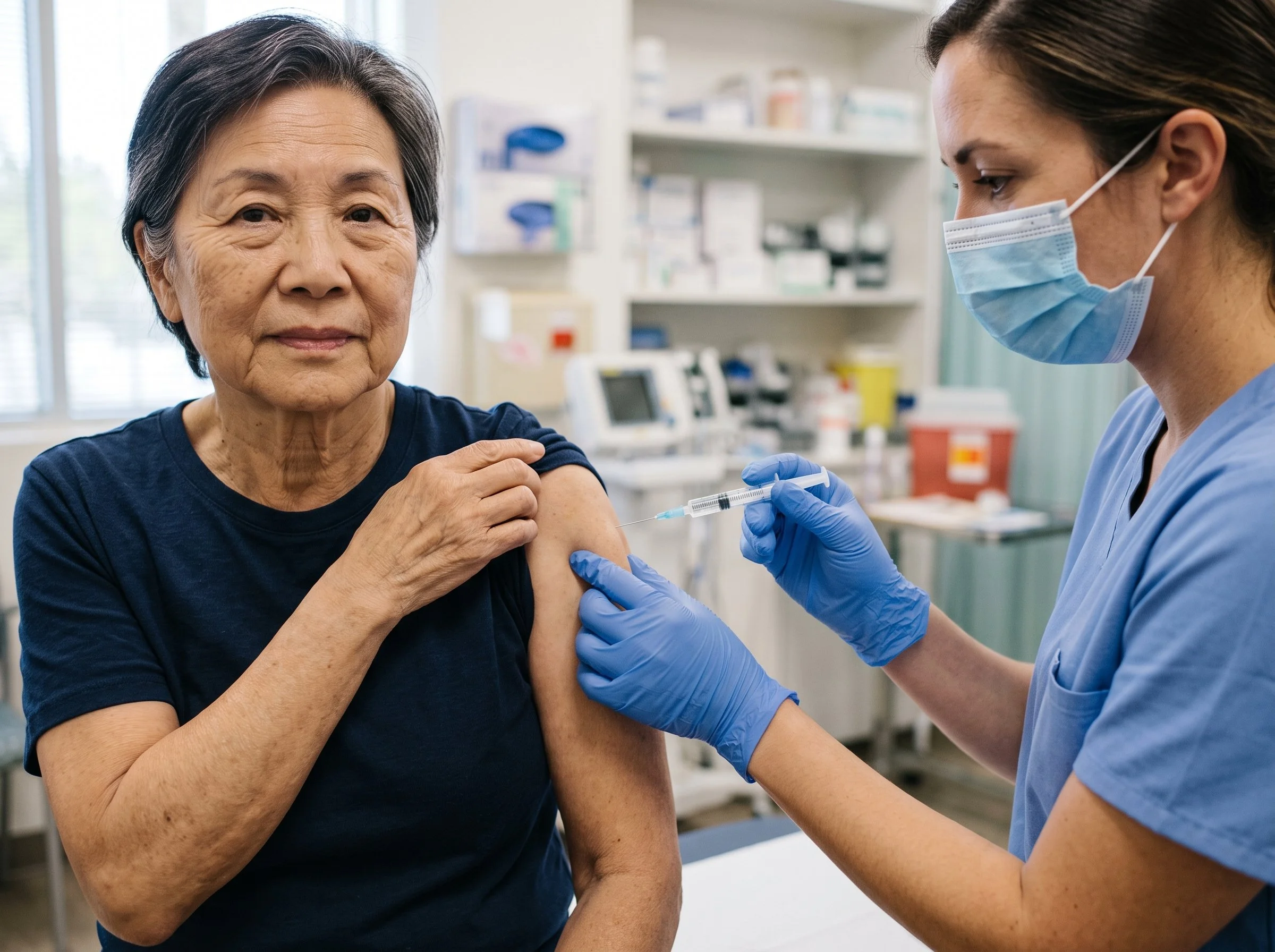
Current CDC guidance is straightforward. The Shingrix vaccine is recommended for all adults age 50 and older, and for adults 19 and older who are immunocompromised. It is given as two doses spaced two to six months apart, and it is over 90 percent effective at preventing shingles.
Despite the recommendation and the strong evidence, only about one third of eligible adults have been vaccinated. That is a lot of missed opportunity, particularly given what we now know about the cardiovascular and cognitive benefits.
You should still get the vaccine even if you have already had shingles, since the virus can reactivate again. You should also still get it even if you got the older Zostavax vaccine years ago, since Shingrix works differently and is substantially more effective.
The vaccine is not recommended during active shingles infection, during pregnancy, or if you have a serious allergy to any component. Most patients experience some soreness at the injection site and occasionally a day or two of feeling run down, particularly after the second dose. Those side effects reflect your immune system responding, which is exactly what you want.
If you are over 50 and have not received the Shingrix vaccine, please put it on your list. If you are one of my patients with established coronary artery disease, prior heart attack, high blood pressure, or a family history of stroke or dementia, please move it near the top of that list. Based on the current evidence, this is now one of the few vaccines that appears to protect against the two conditions patients ask me about most: the heart attack they are trying to avoid and the cognitive decline they are trying to outrun.
Come see us, or ask us at your next visit. This is exactly the kind of upstream, prevention-focused intervention a concierge practice is built to help you navigate.